

As we approached the cathedral of Santo Domingo de la Calzada, my father and I heard hens clucking. Loudly.
“Are those the chickens from inside the church?” my father asked.
“It can’t be—the chickens are way inside the church. We wouldn’t hear them out here.”
And then I saw it—a man carrying a pet carrier, walking away from the cathedral.
As we approached, the hens clucked again—louder this time.
“They’re in there!” I said excitedly.
—
Let’s go back a little bit here and cover why there are hens in a church along the Camino de Santiago to begin with.
Back in the 14th century, a German couple and their son were traveling the Camino on their way to Santiago de Compostela.
An innkeeper’s daughter became infatuated with their son, but he did not return her advances. Angered, she hid a silver goblet in his belongings and then accused him of stealing it.
He was tried, convicted, and sentenced to death by hanging.
(Note to young women: If a man resists your advances, just walk away. Having him killed isn’t good karma.)
So the German parents, obviously deeply grieving, continue their walk to Santiago de Compostela.
In those days, once you got to Santiago, you turned around and walked home. (Some pilgrims still do this today. Like the guy I wrote about a few weeks ago with his donkey.)
Anyway, back to our story.
When the parents returned to Santo Domingo de la Calzada, they found their son still alive—apparently held up by St. Dominic.
They immediately went to the judge, who was in the middle of a chicken dinner, and told him their son was alive in the gallows. The judge said, “Your son is no more alive than the chicken on my plate.”
At which point a rooster and hen sprang to life in front of him.
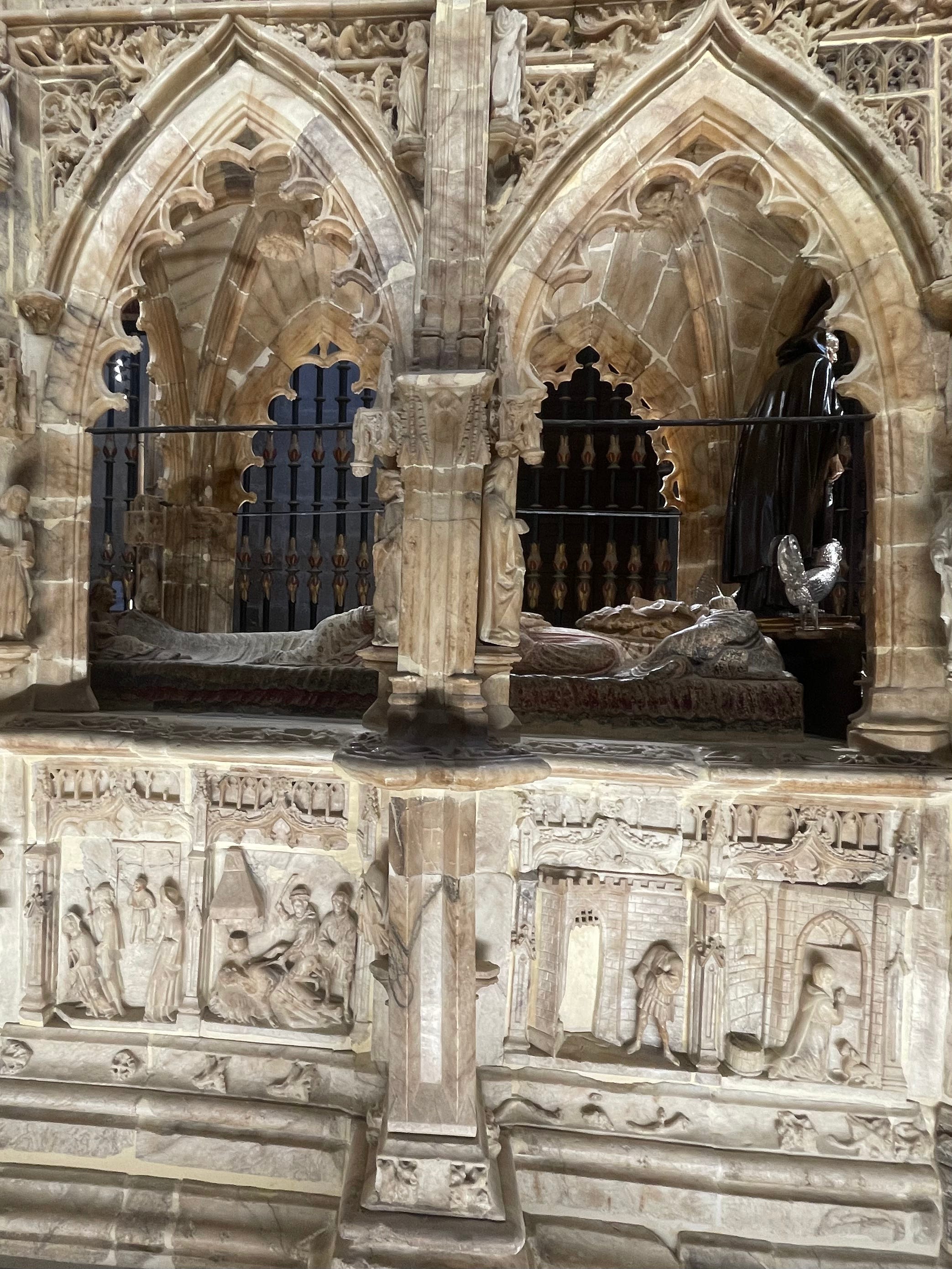
So since 1350 (according to written documents), there have been chickens in the church at Santo Domingo de la Calzada—to commemorate this miracle.
—
I’d heard the chickens were kept at the pilgrim hostel and rotated out every week or so. So I inserted myself into the conversation the chicken-carrying man was having with two other women.
I asked if those were indeed the chickens that had just come from the church and if they were the group responsible for moving them. The women pointed to the chicken-carrying man and said, in essence, “It’s all him.”
The Spanish women, apparently having had all their questions answered, excused themselves. But I had more questions, and Javier’s huge smile indicated he loved answering them.
Javier was delighted to tell us he changes the chickens out every four days. As he has been doing for eight years.
“And when you go on vacations, someone takes over for you?”
Turns out Javier never leaves town for more than 3 days.
He asked if we knew the story of the chickens.
“Yes, my father and I ended our first Camino here in 2019,” I explained.
“Your first?”
“Yes. This is our sixth together.”
Javier looked at my father. “How old is he?”
Javier only speaks Spanish, so I had been punctuating our conversation with English translations for my father. But I already knew Dad’s answer.
“How old do you think he is?” I asked Javier.
“70.”
“He’ll be 79 next month.”
After Javier’s stunned look and congratulations, conversation continued—with clucking chickens as our background music.
—
I knew St. Dominic (Santo Domingo in Spanish) founded the town now called Santo Domingo de la Calzada back in the 11th century.
“So why did he choose here?” I asked.
Javier explained that when Dominic García arrived (in the early 1030s), the area was forested and the only structure was a king’s hunting lodge that had fallen into disrepair.
Dominic was looking for a place to settle as he’d been kicked out of his previous order. (Research tells me this could be a hagiography—a story written about a saint centuries after his death to dramatize his life and basically make a better story. But I like a good story. So let’s stick with this one.)
Anyway, Dominic comes upon this hunting lodge. He knows pilgrims walk through this region, but there isn’t much infrastructure for them. Nor one clear route.
So he takes his sickle and starts clearing a path in the forest. And he fixes up the hunting lodge. And builds a church.
Pilgrims prefer to take the easiest route, so upon seeing a cleared path, they follow it.
Dominic eventually turned his “path” into a stone road. And built a bridge over the nearby river Oja. And that hunting lodge? It became a hospice/hospital/place of hospitality welcoming pilgrims.
Dominic spent the rest of his life serving pilgrims walking to Santiago de Compostela.
When he died in 1109, he was buried in the church on the site. Fifty years later, a cathedral was constructed on that same site and St. Dominic’s remains are there to this day.
—
“And do you know about the tower?” Javier asked, pointing to the structure across the square.
“Nooo. . .”
“It’s collapsed twice.”
I translated for my father who said, “I’m not going up there.”
“When was the last time it fell?” I asked.
Javier blew air out through pursed lips, tossing his hand back to indicate quite some time ago.
He told us a story about poor foundations and the eventual use of bulls horns buried three meters down to make the ground more stable. What’s truth and what’s local legend?
Who knows.
But I like Javier.
And, as I said, I like a good story.
Especially when there are chickens clucking nearby.
We are standing outside the former hunting lodge—now a 4-star Parador hotel in which Dad and I stayed back in 2019. A man has been standing on his hotel room balcony above us listening in. A couple having a drink in front of the hotel are also clearly interested in either the Spanish or my translations.
I decide I’ve held up Javier and those poor chickens long enough.
Before we go, however, he pulls out a gift for us: a small card. St. Dominic is pictured on one side—a chicken and hen at his feet, a sickle in his hand. On the other side, the prayer of St. Dominic.
—
Did I mention Dad and I haven’t even started walking yet? And did I mention Pedro— whom we met at the convent by the other 4-star Parador hotel (in which we’re staying)?
Well, that will have to wait for another time. It’s nearly midnight here. And we’re due to start a loooong walk tomorrow.
Wish us luck.




Note: Dad and I are doing a 7-day walk on the Camino Francés starting in Santo Domingo de la Calzada and ending in Fromista.
It’s nearly midnight here—but there are so many interesting people to meet and things to do, and I wanted to capture this story! Here’s hoping I find time to write earlier in the day so I can get to bed at a reasonable hour!
This is one of my favorite stories along the Camino!
Buen Camino!