

“English? Spanish?” the priest asked the line of us standing in front of him at the altar.
He had just finished the evening pilgrim mass and had invited all the pilgrims to stand before him.
Except I wasn’t a pilgrim.
I was in Logroño, Spain to visit my dear friend Chris. He was volunteering at the local albergue (pilgrim hostel) in that town for two weeks. “After the pilgrim mass here, the priest does something quite special,” Chris had told me earlier. “He explains some of the details of the church to the pilgrims.” And so, at seven o’clock, we found our seats and waited.
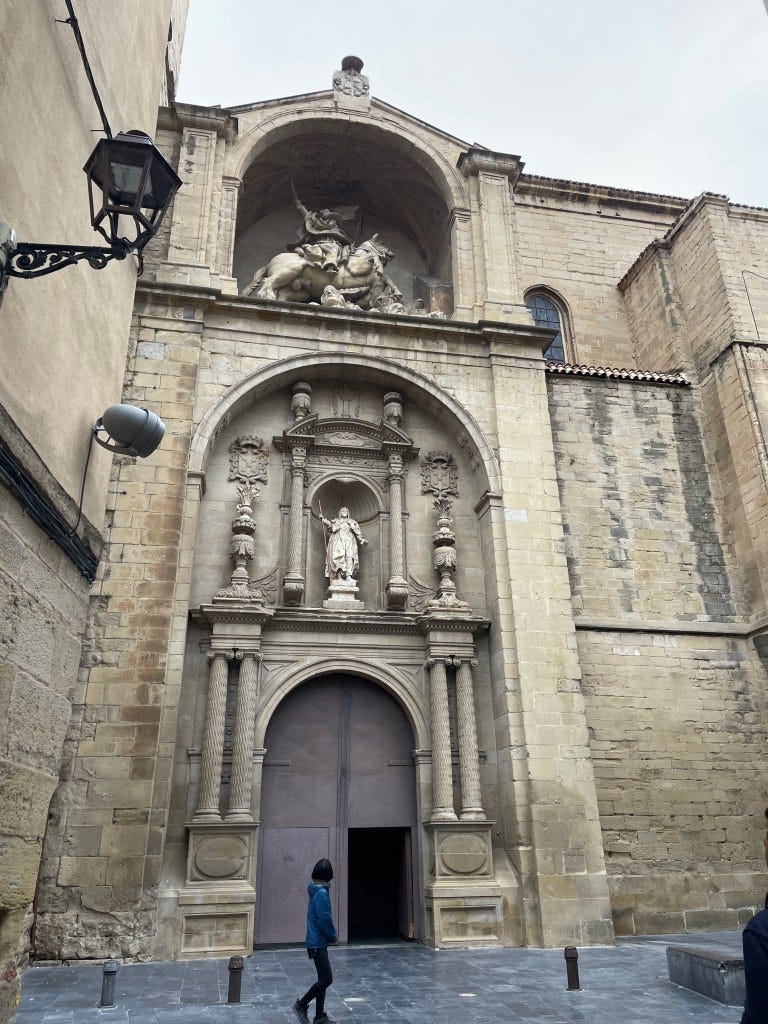
Due to the echo of the microphone, I couldn’t follow most of the Spanish mass. But based on what Chris had told me earlier, I understood when the priest invited the pilgrims to come forward.
Chris stood up and beckoned for me to follow him. But I’m not a pilgrim right now. I’m not walking the Camino. I’m just here to see my friend.
I followed Chris up, but scooted into the front pew instead of standing with the pilgrims. Chris turned and looked at me, tilting his head to tell me to join, so I gave in.
“English? Spanish?” the priest asked again, in Spanish. People murmured that they spoke one or the other.
“French?” one pilgrim asked.
“I don’t speak French,” the priest said, with a kind smile.
“Is there anyone here who speaks both Spanish and English?” he asked.
Chris and I looked at each other. Chris raised his hand. (I could carry on hour-long conversations in Spanish, but Chris had been married to a Cuban woman for 50 years. So I figured I’d leave the translating to him.)
“I’m going to speak in Spanish and if you could translate into English for me, please,” the priest instructed. Then, to the group, “I would like you all to tell me your name and what country you are from, starting over here.” He nodded to one end of the line of us.
Chris started his introduction. But we were not at the end of the line. So I murmured to Chris, “He wants us to start at the end of the line.” And it was then I remembered that Chris didn’t have his hearing aids with him, so probably didn’t hear all of the instructions.
So I bent at my waist to take a look one way and then the other down the line of pilgrims and translated the priest’s instructions from Spanish to English.
Ireland, Taiwan, France, Germany, US, Romania, England.
When the 25 of us finished, he asked, “Where are you all going?” I repeated his question in English, after which the priest said it in French, with a sly smile toward the French couple.
“To Santiago,” the others said.
“Where is Santiago?”
We all looked around trying to figure out which direction was west. Some pointed one way, then another. Seeing the look of confusion, the priest clarified, pointing to the large altar piece towering behind him.
“Where is Santiago?”
Ah. He didn’t mean the city of Santiago de Compostela, to which the pilgrims were walking. He meant St. James himself (Santiago in Spanish). By this point, most of these pilgrims had probably been on the Camino for two weeks. You get to recognize St. James pretty quickly when you’re walking a pilgrimage trail towards his supposed remains.
We all pointed to the central figure in the altarpiece. Then, a red dot appeared on St. James’ face. The priest had a laser pointer! “Yes, there he is. There’s his hat, the shell.” I continued translating, grateful the priest was stopping after every phrase so I didn’t have to remember too much before I translated for the group. The priest continued to translate into French after I was finished.


“Who was Santiago?” he asked.
“One of the 12 apostles,” we murmured. Pilgrims learn that fact pretty quickly on the Camino as well.
“He was the first apostle to be martyred,” the priest informed us. “And he’s the only apostle whose martyrdom is recorded in the Bible.” These two facts were completely new to me. “Do you know how he died?”
Chris and I, who have each walked Camino routes more than 12 times, knew the answer. But we were not there to show off. So we waited. When it was clear no one else knew, Chris and I put our hands up to our necks and slid them from left to right, proud students in this morbid game.
“Yes. He was beheaded.”
Would I have been as good a translator had I not already known the stories of St. James’ life, death, and posthumous wanderings? Who knows. I wasn’t thinking about that. I was intently focused on every word. I had a job to do and, as my Catholic school education had taught me, I was going to give my absolute best.
The priest turned his red laser to another image behind him -- a man on his knees, holding his head in his hands. The red dot then jumped to a man above him, wielding a sword, clean of any blood, I noticed.
“Where was he killed?” Chris and I took this one after some seconds of silence.
“Jerusalem.”
“Where is Santiago buried now?” Oh, good. Another one we all knew. The pilgrims were headed to see where he was supposedly buried. In Santiago de Compostela, in Spain’s northwest corner.
“So if he was killed in Jerusalem and is buried in Santiago de Compostela, how did he get there?”
One of the pilgrims knew about the stone boat.
“They brought his body to Padrón,” the priest explained. I translated. Again the priest turned to the wall of carved images behind him, running his red beam of light across a boat.


He circled other figures with the laser. “There’s Santiago. And there. And there. And there. This is the only church where the life of Santiago is shown on an altarpiece like this. Not even in Santiago de Compostela do they have this,” he said.
We stood there, stunned, our eyes running over everything in front of us.
The priest raised his hands over us for a final blessing. “That they will find light in the darkness, food when they are hungry, shelter when they are tired. That they arrive safely to Santiago and safely back to their homes again.”
He wished us all a “Buen Camino,” stepped off the altar, and disappeared behind a door.
“Thanks for for translating,” the Irish woman said.
Chris turned to me. “That’s the only time I’ve felt bad not having my hearing aids.”
I thought about this and later thanked him. “I didn’t think I deserved to be up there at first. If it wasn’t for you forgetting your hearing aids, I would have stood there feeling like an imposter. So thank you, my friend. Of all the times I’ve been able to translate for someone, this is the one I’m most proud of.”


week after week, you keep reminding me of the fact that I want to walk this thing!
Never an imposter. Always the pilgrim!